
2026 Best Embedded PC for Industrial Automation?
Choosing the 2026 best Embedded Pc for industrial automation requires more than comparing processor speeds. Factory floors demand dependable performance, stable communication, and predictable operation under pressure.
An experienced engineering review should examine temperature ranges, vibration resistance, fanless cooling, and long-term component availability. The system may control a robotic arm, collect sensor data, or connect several PLC networks. Each task creates different requirements.
Real installations reveal what brochures often miss. A compact computer beside a conveyor may face dust, electrical noise, and restricted airflow. Dual Ethernet ports, isolated I/O, and support for protocols such as EtherCAT or Modbus TCP can simplify deployment. Secure boot, TPM support, and manageable remote updates also deserve close attention.
Performance matters, but only within the application.
A powerful CPU cannot fix poor thermal design. Likewise, excessive memory may add cost without improving machine output. During testing, engineers should measure startup time, sustained workloads, storage reliability, and recovery after power interruption. These results are more useful than a single benchmark score.
There is no universal winner. A food-processing line may prioritize sealed construction, while machine vision may require GPU acceleration. Some manufacturers also need five or more years of supply stability. That promise should be verified, not assumed.
This guide compares leading options through practical industrial criteria, documented specifications, and field-oriented reasoning. The conclusions may change as software demands evolve. That uncertainty matters. A careful buyer should validate every shortlisted Embedded Pc with real sensors, cables, workloads, and environmental conditions before approving production use.
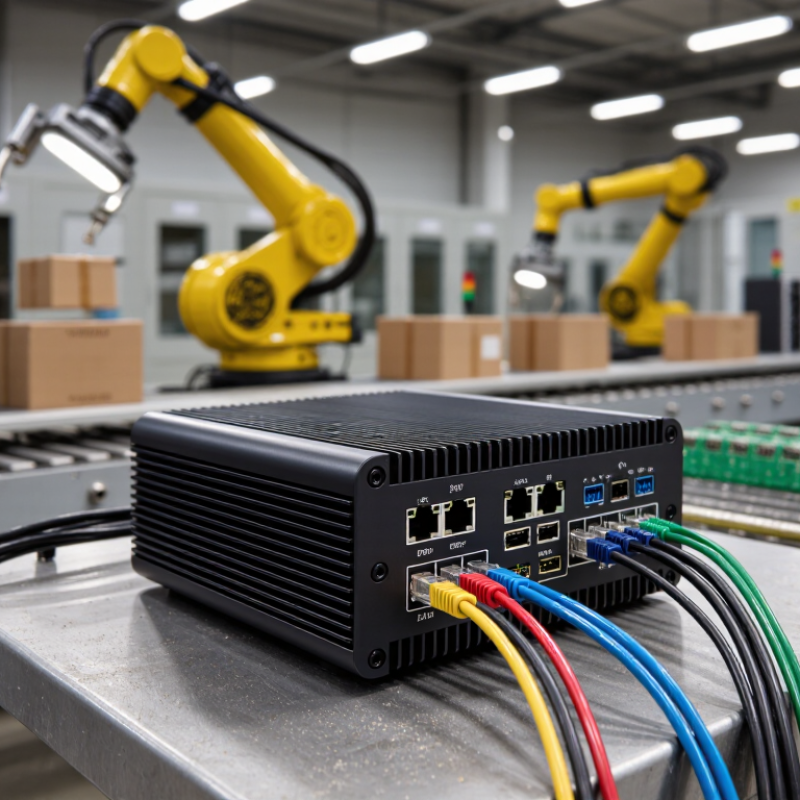
What Is an Embedded PC in Industrial Automation?
2026 Best Embedded PC for Industrial Automation?
What Is an Embedded PC in Industrial Automation?
An embedded PC is a compact computer built to control, monitor, and analyze industrial equipment. Unlike a standard office computer, it operates near machines and sensors. It may manage conveyor belts, robotic cells, inspection cameras, or temperature systems. These computers often use industrial processors, solid-state storage, and fanless cooling. Fewer moving parts can reduce dust-related failures.
In daily automation work, the embedded PC receives data from sensors and controllers. It then runs software, displays machine status, or sends commands through industrial communication protocols. Low-latency processing matters when a motor must stop within milliseconds. A durable enclosure also helps protect electronics from vibration, heat, and electrical noise. DIN-rail mounting can simplify cabinet installation.
Choosing one requires more than checking processor speed. Engineers should examine operating temperature, memory capacity, storage endurance, and expansion options. Serial ports, Ethernet interfaces, and digital I/O may be essential. Security features also deserve attention, including controlled access and secure system updates. In field deployments, I have seen overheating cause more trouble than slow processing. That lesson is easy to overlook. A larger heatsink may help, but it cannot fix poor cabinet ventilation. Long-term reliability depends on testing the complete system, not only the computer. Real production conditions can reveal weaknesses that laboratory tests miss.
Which Hardware Specifications Matter for 2026 Applications?
2026 Best Embedded PC for Industrial Automation?
Which Hardware Specifications Matter for 2026 Applications?
For 2026 industrial automation, the best embedded PC is not simply the fastest box. Hardware specifications must match the machine’s workload, environment, and service plan. In factory testing, a modest processor can control sensors reliably, while poor thermal design causes random resets. That lesson is easy to forget.
A modern system needs CPU headroom for vision, motion logic, and local analytics. Four or eight cores may help, but stable performance matters more than peak speed. At least 16 GB of industrial-grade RAM suits mixed workloads. Error-correcting memory is valuable where downtime is expensive. NVMe storage speeds logging and software updates, yet endurance ratings deserve careful review. Write-heavy data can damage ordinary drives. It happens quietly.
Industrial I/O should include isolated digital channels, accurate analog inputs, serial communication, and flexible Ethernet connectivity. A missing port can force an awkward converter. Wide-voltage DC input, surge protection, and reverse-polarity protection reduce field failures. Fanless cooling lowers maintenance, but it may struggle inside a hot cabinet. Test thermal cycling, vibration, and dust exposure before approval. Secure boot, hardware-based encryption, and long software support also matter. I would not trust a “rugged” specification without test records, repair guidance, and a realistic seven-year supply plan.
How Do Connectivity and Industrial Protocols Affect Compatibility?
2026 Best Embedded PC for Industrial Automation?
Connectivity now determines whether an embedded PC fits a real production line. A fast processor is not enough. The system must communicate with sensors, drives, controllers, cameras, and supervisory software without fragile converters. Common interfaces include dual Ethernet, serial ports, USB, CAN, and isolated digital I/O. Protocol support matters equally. Modbus TCP suits many legacy devices, while OPC UA and MQTT support structured data exchange and cloud-connected workflows. Time-sensitive Ethernet is valuable when motion control needs predictable timing.
Industry growth makes this issue harder. The International Federation of Robotics reported 541,302 industrial robots installed worldwide in 2023. Each installation can introduce another communication requirement. IoT Analytics estimated 18.8 billion connected IoT devices in 2024, with the total potentially reaching 39 billion by 2030. More devices mean more gateways, firmware updates, and cybersecurity checks. A compact PC with only one network port may look efficient, but it can become a bottleneck quickly.
In field evaluation, I would test protocol stability during cable faults and power recovery. I would also verify driver support, real-time performance, and long-term operating temperature. The Deloitte 2023 Smart Manufacturing and Operations Survey found that 86% of leaders viewed smart manufacturing as a major competitiveness driver. Still, compatibility claims deserve skepticism. A protocol listed on a specification sheet may not support every function required by a machine cell. That small difference can delay commissioning.
How Should Reliability, Security, and Lifecycle Support Be Evaluated?
For a 2026 industrial automation PC, reliability means more than a high MTBF number. It means predictable operation beside heat, dust, vibration, and electrical noise. Check temperature ratings, ECC memory, watchdog recovery, storage endurance, and tested power-loss behavior. The 2024 Annual Outage Analysis reported that 53% of surveyed organizations experienced a significant outage within three years. That figure makes recovery testing essential, not optional. Ask for field-failure evidence, not only laboratory claims.
Security evaluation should follow a documented threat model. Secure boot, signed updates, hardware-rooted keys, least-privilege services, audit logs, and an accessible software bill of materials should be standard. The 2024 Data Breach Investigations Report recorded a 180% increase in vulnerability exploitation as an initial access method. Yet security can reduce availability when patches are rushed. Require staged updates, rollback, offline recovery, and a clear patch-support timeline. IEC 62443 and NIST SP 800-82 provide useful evaluation references.
Lifecycle support is often the uncomfortable test. Confirm processor availability, BIOS continuity, spare inventory, repair options, and formal end-of-life notices. A practical contract should define security updates, replacement compatibility, and response times for at least seven years. Do not assume a ten-year promise protects your application. It may exclude storage, memory, or operating-system changes. I would score lifecycle risk separately, then test a replacement unit with the original image, cables, and control software. If commissioning takes days, the platform is not truly sustainable.
2026 Best Embedded PC for Industrial Automation? - How Should Reliability, Security, and Lifecycle Support Be Evaluated?
| Evaluation Category | Evaluation Dimension | Recommended 2026 Target | Why It Matters in Industrial Automation | How to Verify | Priority |
|---|---|---|---|---|---|
| Reliability | Operating temperature | At least -20°C to 60°C for standard installations; wider ranges should be selected for outdoor or harsh environments. | Reduces thermal-related shutdowns, component aging, and unexpected controller resets. | Review the manufacturer specification and request temperature test reports under the intended load. | Critical |
| Reliability | Shock and vibration resistance | Compliance with the applicable IEC 60068 test methods and qualification for the installation environment. | Protects storage, connectors, solder joints, and cooling assemblies from machinery vibration and transport shock. | Check test conditions, acceleration levels, frequency ranges, duration, and mounting orientation in the test report. | Critical |
| Reliability | Fanless thermal design | Fanless operation where the processor performance and ambient temperature requirements permit it. | Eliminates a moving part, lowers dust intake, and can reduce maintenance requirements. | Confirm sustained-load thermal performance rather than relying only on peak benchmark results. | High |
| Reliability | Industrial power input | Wide-range DC input suitable for the control cabinet, with reverse-polarity, over-voltage, over-current, and surge protection. | Helps prevent failures caused by unstable cabinet power, wiring mistakes, and electrical transients. | Verify input range, protection functions, grounding requirements, and transient test results. | Critical |
| Reliability | Storage endurance and power-loss protection | Industrial-grade solid-state storage with documented endurance; protected write cache or controlled shutdown support. | Reduces file-system corruption and data loss during brownouts or emergency stops. | Check endurance rating, power-loss behavior, SMART monitoring, and recovery procedures. | Critical |
| Electrical Compatibility | EMC immunity and emissions | Industrial EMC qualification aligned with IEC 61000-6-2 immunity and IEC 61000-6-4 emissions, where applicable. | Limits interference with sensors, drives, PLCs, safety systems, and communication networks. | Request accredited test documentation and confirm the exact product configuration tested. | Critical |
| Security | Secure boot and trusted platform hardware | UEFI Secure Boot, TPM 2.0, signed firmware, and hardware-backed key storage. | Blocks unauthorized boot software and improves device identity and disk-encryption security. | Confirm Secure Boot policy, TPM version, firmware-signing process, and key-management workflow. | Critical |
| Security | Industrial cybersecurity alignment | Security processes mapped to IEC 62443 principles, including asset identification, access control, patching, and vulnerability response. | Supports risk-based protection of industrial control-system assets. | Review security documentation, vulnerability disclosure policy, update process, and hardening guidance. | Critical |
| Security | Network segmentation and remote access | At least two independent network interfaces, configurable firewall rules, disabled unused services, and controlled remote administration. | Separates control traffic from enterprise or maintenance networks and reduces attack surface. | Test VLAN, firewall, certificate, VPN, user-role, and logging functions in the deployment architecture. | High |
| Performance | Real-time and workload suitability | Select CPU, memory, and storage based on measured PLC, HMI, vision, database, or edge-AI workload—not nominal core count alone. | Prevents missed scan deadlines, interface lag, and performance degradation after software updates. | Run the actual application stack with peak I/O, network, storage, and thermal loads. | Critical |
| Connectivity | Industrial I/O and expansion | Required quantity of isolated serial, digital I/O, USB, Ethernet, fieldbus, and expansion interfaces with long-term driver support. | Reduces external converters, wiring complexity, cabinet space, and additional failure points. | Verify pinouts, isolation ratings, protocol compatibility, driver availability, and simultaneous-port operation. | High |
| Lifecycle Support | Product availability period | A documented availability commitment of at least 5 years; 7–10 years is preferable for long-lived automation projects. | Prevents redesigns, requalification costs, and unexpected component substitutions. | Obtain a written lifecycle statement, last-order notice policy, and replacement-product strategy. | Critical |
| Lifecycle Support | Operating-system and firmware maintenance | Stable OS image, BIOS or UEFI update process, security-patch guidance, rollback capability, and version-controlled drivers. | Maintains security and application compatibility without introducing uncontrolled changes to production systems. | Review release notes, update cadence, support matrix, offline update options, and rollback testing. | Critical |
| Maintainability | Field serviceability | Tool-accessible enclosure, replaceable storage or memory where appropriate, clear status indicators, and documented recovery procedures. | Shortens mean time to repair and reduces production downtime. | Measure replacement time, verify spare-part procedures, and test image restoration after a simulated failure. | High |
| Compliance | Regulatory and installation compliance | Required regional safety, EMC, environmental, and hazardous-location approvals for the final installation. | Avoids certification gaps that can delay commissioning or restrict use in regulated facilities. | Check certificates for the exact model, power supply, enclosure, accessories, and target market. | Critical |
| Total Cost of Ownership | Five-year ownership cost | Evaluate purchase price together with engineering, accessories, energy use, support, spare units, downtime, and replacement costs. | A lower acquisition price does not necessarily produce the lowest lifecycle cost. | Use a five-year cost model with documented assumptions and a sensitivity analysis for downtime and replacement. | High |
How Can Total Cost and Application Fit Guide the Final Choice?
2026 Best Embedded PC for Industrial Automation?
How Can Total Cost and Application Fit Guide the Final Choice?
The best embedded PC is rarely the cheapest unit on a purchasing sheet. Application fit matters more. A packaging line may need fanless cooling, wide-temperature operation, isolated I/O, and stable performance beside motors. A vision station may need stronger graphics, faster storage, and predictable latency. These requirements change the real price.
IDC’s 2024 Worldwide Edge Spending Guide forecasts global edge spending at about $232 billion in 2024. It expects nearly $350 billion by 2027. This growth reflects more local processing in factories, where latency and uptime influence production. MarketsandMarkets estimates the industrial PC market will grow from $5.4 billion in 2023 to $7.7 billion by 2028. The opportunity is clear, but forecasts do not remove engineering risk.
Total cost should include integration labor, software licensing, power use, thermal controls, maintenance, and replacement downtime. A low-cost computer can become expensive after repeated storage failures or difficult remote service. My first estimate is often wrong. I now measure cabinet space, connector access, boot time, and recovery procedures before comparing prices. A five-year calculation also needs spare-unit strategy and lifecycle support. IEC 62443 guidance further encourages planned security controls, patching, and network segmentation. Those tasks require budget and skilled staff. A practical choice balances compute headroom with proven reliability, instead of buying specifications that the application never uses.
2026 Best Embedded PC for Industrial Automation? How Can Total Cost and Application Fit Guide the Final Choice?
Five-year total cost of ownership varies significantly by workload. Hardware price is only one part of the decision; integration effort, maintenance, and the financial impact of downtime can be more important in continuous industrial operation.
Planning benchmark in USD for a five-year, 24/7 deployment model. Estimates include hardware, initial integration, maintenance, and downtime exposure. Application-fit scores reflect thermal, compute, connectivity, expansion, and lifecycle requirements on a 0–100 scale.
Ready to talk about water treatment?
Contact us
Please complete this form and we will be in touch