China Best Cooling Water Treatment Chemicals Suppliers?
Choosing a cooling-water treatment supplier is not just a price comparison. It is a decision about corrosion control, scale prevention, microbial management, and the reliability of daily operations. A cooling tower may look simple from the ground, but inside it, warm water, metal surfaces, and changing chemistry interact constantly. Small details matter.
Dr. Mark W. LeChevallier is a recognized water microbiologist whose work addresses microbial risks in water systems. I cannot verify a verbatim statement from him specifically about cooling-water chemicals, so I will not invent one. A useful editorial principle for this guide is: “A treatment program works only when chemistry, monitoring, and operating practice work together.” This is a guide’s wording, not a quotation attributed to Dr. LeChevallier.
The best cooling water treatment chemicals suppliers in China should offer more than a product catalogue. Buyers can assess technical support, clear dosing guidance, compatibility with system materials, and access to reliable testing. Ask how the supplier handles changing water quality, seasonal loads, and unexpected deposits on heat exchangers. Request product documentation and practical service details, not broad promises.
This introduction frames the supplier comparison around evidence and operating fit. A low initial price may not reflect total system cost. Nor does a polished brochure prove performance. The right choice depends on the facility’s water, equipment, operating data, and maintenance capacity. Some questions will remain open until site conditions are measured. That is worth acknowledging.
What Cooling Water Treatment Chemicals Do Industrial Systems Need?
Industrial cooling systems need a treatment program, not one universal chemical.
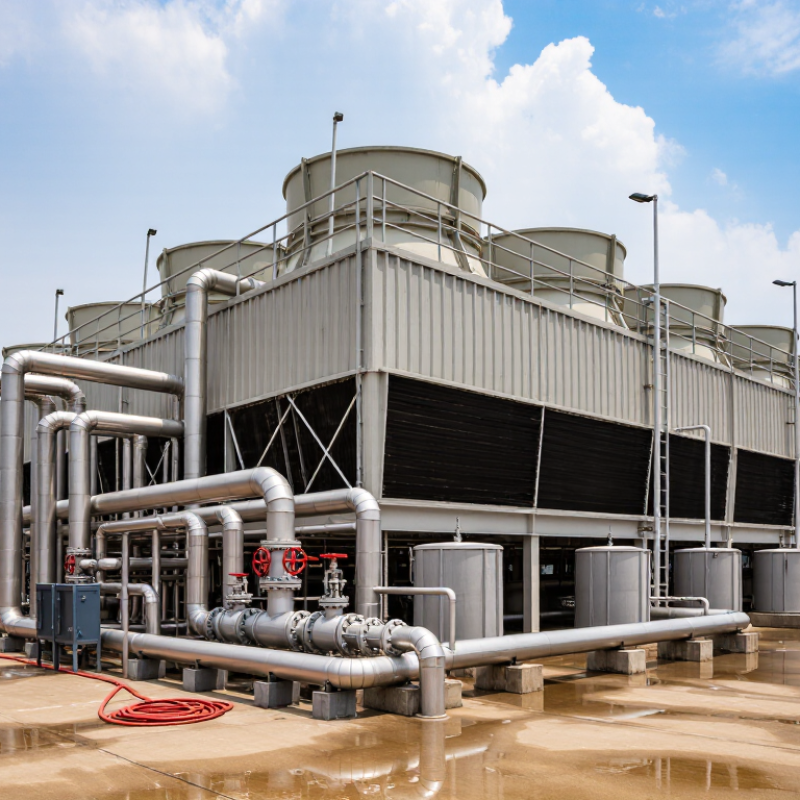
In open recirculating towers, evaporation concentrates dissolved minerals. This can leave hard scale on heat-transfer surfaces.
Scale inhibitors help keep mineral salts dispersed, while controlled blowdown limits concentration. Small changes in makeup-water quality can alter the balance.
Corrosion inhibitors protect steel, copper, and mixed-metal circuits. The right blend depends on metallurgy, pH, temperature, and discharge requirements. A system with copper-alloy exchangers may need different protection from an all-steel loop.
Biocides control bacteria, algae, and biofilm. Operators may alternate oxidizing and non-oxidizing products when monitoring supports it.
Dispersants can help carry suspended solids out.
Chemical treatment works best when dosing follows measured water conditions. Teams should check pH, conductivity, hardness, iron, microbial activity, and corrosion coupons, then adjust feed rates gradually. A clean-looking basin is not proof. Visual checks can miss early biofilm. There is no perfect formula; source water shifts, sensors drift, and process changes matter.
Not always obvious.
Record treatment changes and review results with a qualified water-treatment specialist before changing the chemistry.
How to Evaluate Cooling Water Treatment Chemical Suppliers in China
China Best Cooling Water Treatment Chemicals Suppliers?
When evaluating cooling water treatment chemical suppliers in China, look beyond product lists and price quotes. A reliable supplier should ask about your system’s makeup water, operating temperature, metallurgy, and cycles of concentration. These details affect corrosion, scale, and biological control. A generic recommendation may not fit your cooling tower.
Request recent product specifications, safety data sheets, and batch quality records. Ask how the supplier supports dosage trials and monitors results, such as corrosion coupons, conductivity readings, and deposit inspections. Practical technical support matters. Can staff interpret your water analysis and explain adjustment limits?
Check whether delivery schedules, packaging, and export documentation are clearly described. Short answers can be revealing. This part is easy to overlook. Compare references from facilities with similar water conditions, but verify what those references actually demonstrate.
A polished test report is useful, though it cannot replace a controlled trial at your site. It is also worth questioning assumptions: water chemistry changes seasonally, and even a well-matched treatment program may need adjustment.
Which Product and Service Capabilities Distinguish Top Suppliers?
Top cooling-water treatment suppliers distinguish themselves through diagnosis, not a long product list.
They review makeup-water chemistry, system materials, operating temperatures, and seasonal loads before recommending inhibitors, biocides, or scale-control programs. A capable representative explains each treatment’s purpose and its limits.
Clear answers matter.
Ask whether the supplier can support corrosion-coupon monitoring, deposit inspections, and routine site adjustments. These services connect chemical choices with measurable indicators, including conductivity trends, corrosion rates, and heat-transfer performance.
Reliable suppliers provide handling guidance, current technical data, and dosing instructions operators can follow during busy shifts. They should flag interactions with existing materials and treatment steps, rather than promise a universal formula.
Small details count.
Check response times and stock planning, and ask how recommendations change when water quality shifts after heavy rain or equipment changes.
One gap is easy to miss: a detailed report can still leave operators unsure what to do next.
Compare documented monitoring methods and service records, then verify that proposed targets fit your actual system.
How to Verify Supplier Quality, Certifications, and Compliance
When comparing cooling water treatment chemical suppliers in China, verify documents against the product you will actually receive. Request a current safety data sheet, technical data sheet, and certificate of analysis for a recent batch. Check that the product name, concentration, and test methods match across all three. Paper is not proof. Ask how samples are tested and whether batch records can be traced to production dates.
Review certifications carefully. Confirm the issuing body, certificate number, expiry date, and certified site or activity; a valid quality-management certificate may not cover every product or facility. Details matter. Ask for evidence of quality controls, change notifications, and complaint handling. For compliance, compare ingredients and labeling with the rules that apply at your destination, then confirm transport and storage requirements with your own safety team. Local discharge limits also matter, because a treatment program can affect wastewater conditions. An experienced supplier should explain dosage monitoring and provide practical guidance for your water chemistry, not just promise results. I would still verify claims independently: a polished document set can be incomplete, and suppliers may interpret requirements differently.
How to Compare Suppliers and Choose the Right Partner
A supplier’s proposal should reflect your actual water, not a standard dosing sheet. Share recent makeup-water analysis, tower volume, operating temperatures, and blowdown records. Ask how the supplier evaluates hardness, alkalinity, chloride, silica, and suspended solids. These details influence scaling and corrosion control. Request a written explanation of the proposed treatment, target ranges, and monitoring schedule. Clear reasoning matters. A site visit can reveal practical issues, such as uneven flow, clogged strainers, or inconsistent chemical dosing. Ask who reviews test results and how quickly they respond when readings drift.
Compare more than the chemical price. Check whether the quote includes delivery, testing, operator training, and follow-up support. Ask for relevant application references, safety documentation, and a small-scale trial plan where appropriate. A capable partner should explain what success looks like, using measures such as deposit trends, corrosion coupons, and water use. Be cautious of guaranteed savings without a baseline. Even a careful scorecard has gaps; operating conditions change, and one water sample may miss a difficult week. That is easy to overlook. Share your plant’s limits and ask suppliers to state assumptions, exclusions, and how they would adjust treatment if results differ from projections.
China Cooling Water Treatment Suppliers: Compare Support for Higher Cycles of Concentration
A practical supplier discussion starts with how safely a treatment program can manage cycles of concentration while controlling scale and corrosion.
Illustrative water-balance calculation: blowdown volume per 100 volume units evaporated = 100 ÷ (cycles of concentration − 1). Assumes no drift or leaks. Actual operating limits depend on makeup-water chemistry, system materials, and site conditions; ask suppliers to explain how they establish and monitor those limits.