How to Choose the Right Industrial Gripper?
Choosing the right Industrial Gripper can determine whether an automated process runs smoothly or fails during a busy production shift. The decision is rarely about gripping force alone. Part geometry, surface texture, weight, temperature, cycle speed, and available robot payload all matter. A gripper that handles a dry steel block may slip on an oily plastic housing.
Begin with the application, not the catalogue. Observe how the part arrives, where it must be held, and what happens if alignment changes slightly. Mechanical fingers, parallel jaws, vacuum cups, and magnetic systems each suit different conditions. Confirm the required force with a safety margin, then test the gripper using real parts. Small differences in casting, dust, or surface finish can expose weaknesses that specifications miss.
Testing matters most.
Reliable selection also requires practical maintenance planning. Check jaw wear, air consumption, sensor feedback, cleaning access, and replacement-part availability. Experienced integrators often review failure records before approving a design, because repeated minor slips can become expensive downtime. Manufacturer data and recognized machine-safety practices should support the decision, but they cannot replace an on-site risk assessment. A useful choice may still need adjustment after installation. That is not necessarily poor planning; production conditions are sometimes less predictable than drawings suggest. This guide explains how to compare Industrial Gripper options with evidence, measurable requirements, and a willingness to question convenient assumptions.
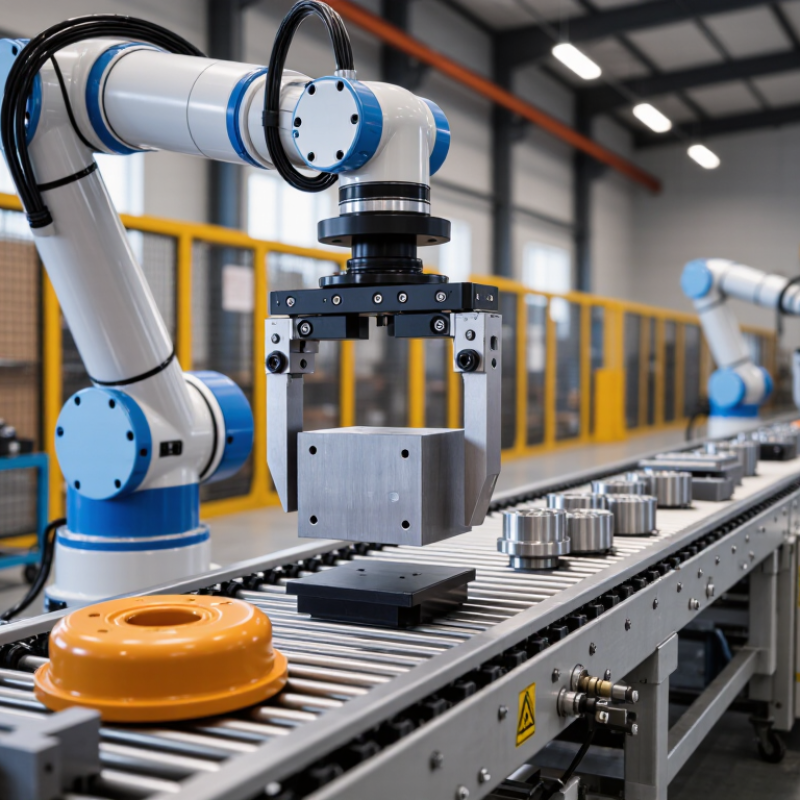
Define Gripper Types by Payload, Part Geometry, and 2024 Automation Needs
How to Choose the Right Industrial Gripper?
Define Gripper Types by Payload, Part Geometry, and 2024 Automation Needs
Payload comes before convenience. A gripper rated for 8 kilograms should not handle an 8-kilogram part continuously. Acceleration, vibration, and tool weight reduce the practical margin. In production tests, I prefer at least 20 percent spare capacity. It prevents sudden drops and unstable robot movements. Check the part’s center of gravity, too. An uneven load can twist the wrist during fast transfer.
Part geometry determines contact, not marketing language. Parallel-jaw grippers suit boxed components, shafts, and flat metal pieces. Three-finger models can center round parts more naturally. Vacuum grippers work well with smooth panels and sealed surfaces. They struggle with dust, porous cardboard, or oily sheets. For fragile items, use softer fingers and controlled gripping force. A narrow contact point may hold firmly but leave marks.
2024 automation projects also demand flexibility. Quick-change tooling supports varied batches and reduces manual adjustment. Integrated sensors can confirm grip position and detect missing parts. Vision guidance helps with changing orientations, but it cannot fix poor mechanical contact. Energy use deserves attention, especially for pneumatic systems running through long shifts. I have seen teams select oversized grippers for comfort. That choice increased cycle cost without improving reliability. Test real parts under real speeds, because laboratory results can feel misleading.
How to Choose the Right Industrial Gripper?
Compare common gripper types by their typical practical payload range, part geometry, and suitability for modern 2024 automation systems.
Selection guide: Pneumatic parallel grippers are well suited to rigid, prismatic parts and high-cycle handling. Three-finger grippers provide better centering for round or irregular parts. Electric grippers offer programmable force and stroke for flexible production. Vacuum grippers work best with flat, sealed surfaces, while magnetic grippers are intended for ferrous metal parts. The payload values shown are typical planning ranges and must be verified against grip force, acceleration, friction, part surface, and safety requirements.
Select Pneumatic, Electric, or Magnetic Drives by Cycle-Time Targets
How to Choose the Right Industrial Gripper?
Cycle time should guide the drive choice, not habit. The International Federation of Robotics reported 541,302 industrial robot installations worldwide in 2023. That scale makes small gripping delays expensive. Start with the complete cycle: approach, gripping, transfer, release, and confirmation.
Pneumatic grippers often suit repetitive, high-speed handling with stable part geometry. They provide strong closing force and simple control. However, air preparation, leaks, and pressure variation can reduce consistency. The U.S. Department of Energy reports that compressed air may consume about 10% of industrial electricity. Electric grippers usually offer adjustable force, position feedback, and easier recipe changes. They can reduce air infrastructure, but their acceleration, thermal limits, and control response need testing. Fast is not always faster.
Magnetic grippers can achieve rapid pickup of ferrous components, especially when surfaces are accessible. They are less suitable for nonmagnetic materials, oily parts, or safety-critical retention without verification. Test the actual workpiece, not a clean sample. Measure gripping confirmation and release time with the robot moving at production speed. ISO 9283 provides a useful framework for evaluating robot performance, but gripper behavior still needs application trials. A spreadsheet can mislead. Leave margin for dust, temperature, part variation, and operator adjustments. The best selection often comes from a timed trial using real parts, real tooling, and the worst expected conditions.
Verify Jaw Stroke, Repeatability, IP Rating, and ISO 9283 Accuracy Data
How to Choose the Right Industrial Gripper?
The global robot market is expanding rapidly. The International Federation of Robotics reported 541,302 industrial robot installations in 2023. That growth increases the cost of small selection errors. Start with jaw stroke, not catalogue opening. Measure the real part range, including tolerances, oil film, and thermal expansion. A 20-millimeter stroke may become unusable when each jaw needs clearance.
Repeatability must match the process. Check whether the specification uses millimeters, plus or minus values, and a defined load. Test repeated gripping at production speed. ISO 9283 provides methods for evaluating robot positioning performance, but gripper repeatability needs its own fixture and cycle test. A spreadsheet can still lie. We once treated unloaded repeatability as production performance, which was a poor assumption.
IP ratings follow IEC 60529. IP67 indicates dust protection and temporary water immersion, but it does not prove resistance to coolant chemistry or abrasive particles. Ask for test conditions and duration. For accuracy, separate gripper positioning from robot accuracy. ISO 9283 data can show pose accuracy and repeatability, yet the complete result also depends on mounting stiffness, payload, and tool deflection. Request measured data, not only a target value. Then repeat the check after temperature stabilization. That detail is easy to miss.
Compare Total Cost of Ownership Using Energy Use, Maintenance, and ROI Metrics
Choosing an industrial gripper requires more than comparing purchase prices. Calculate total cost of ownership over three to five years. Include energy, installation, spare parts, labor, and production losses.
Pneumatic grippers may appear inexpensive, but compressed air creates hidden costs. The U.S. Department of Energy reports that leaks can waste 20–30% of compressor output. Measure air consumption per cycle, not only compressor capacity. A faint hiss near the fitting can become a significant monthly expense. Electric grippers usually avoid compressed-air losses, yet standby power, controls, and battery replacement can affect their return.
Maintenance data deserves equal attention. Track jaw wear, seal replacement, sensor failures, and average repair minutes. McKinsey research has reported that predictive maintenance can reduce downtime by 30–50% and maintenance costs by 10–40%. These figures are useful benchmarks, not promises. Actual results depend on dust, payload variation, cycle speed, and operator habits. The spreadsheet is rarely perfect. Test both options on one production cell for four weeks. Record cycles, stoppages, energy use, and technician time. Then calculate ROI using: annual savings minus added investment, divided by added investment. A gripper saving energy but causing two extra stoppages each week may be the wrong choice. Conversational factory evidence matters.
How to Choose the Right Industrial Gripper? - Compare Total Cost of Ownership Using Energy Use, Maintenance, and ROI Metrics
| Gripper Technology | Typical Payload
(kg) | Average Power or Air Use | Annual Energy Cost
(USD) | Initial Gripper Cost
(USD) | Installation Cost
(USD) | Annual Maintenance
(USD) | Five-Year TCO
(USD) | Estimated Payback
(Years) | Best-Fit Applications |
| Pneumatic Parallel | 2–15 | 100 NL/min at 6 bar | $288 | $900 | $350 | $350 | $4,440 | Baseline | General automation, machine tending, and high-cycle handling where compressed air is already available. |
| Electric Parallel | 2–12 | 80 W average draw | $38 | $2,600 | $500 | $180 | $4,192 | 4.4 | Applications requiring programmable force, position feedback, variable part sizes, and reduced compressed-air consumption. |
| Pneumatic Angular | 1–8 | 80 NL/min at 6 bar | $253 | $750 | $300 | $320 | $3,917 | 1.3 | Compact pick-and-place cells, limited installation space, and applications needing a pivoting jaw motion. |
| Electric Vacuum Gripper | 0.5–10 | 120 W average draw | $58 | $1,400 | $300 | $240 | $3,188 | 1.3 | Smooth, non-porous sheets, cartons, glass, and flat components where mechanical contact is undesirable. |
| Lowest five-year total cost in this benchmark: | $3,188 | Electric vacuum gripper, provided that the workpiece surface and holding force are suitable. |
Calculation Assumptions: 16 operating hours per day, 250 operating days per year, 4,000 operating hours per year, electricity at $0.12 per kWh, and a five-year evaluation period. Compressed-air energy is estimated at $0.11 per standard cubic meter of air, including compressor electricity and typical distribution losses. Five-year TCO equals initial gripper cost plus installation cost plus five years of energy and scheduled maintenance costs.
ROI Note: Payback is an engineering estimate based on annual operating-cost savings compared with the pneumatic parallel baseline. Actual results vary with cycle time, air leakage, duty cycle, payload, tooling, labor impact, downtime, product losses, and local utility rates. Confirm gripping force, safety factor, environmental rating, and part compatibility before final selection.